What the forest is called now.
We've had some fun this past week, haven't we?
The Orangutan Day code hunt started as a simple idea: mark a day that matters deeply to us with something more alive than a sale banner. Watching you snap up the codes — refreshing the page, comparing notes, the shout of triumph when someone landed a big one — has been one of the highlights of my year.
But as the last codes wind up, I'd like to keep you a few minutes longer. Because the fun was carrying something underneath it the whole time — something I've cared about for a long while — and this is the part where I say it properly.
You May Have Noticed The Codes Weren't Random Words
The first drop was easy to love. Hornbill. Sunbear. Kinabatangan, a river in Borneo the colour of strong tea. Leuser, the ecosystem in Sumatra where orangutans, tigers, elephants and rhinos still share one forest — the last place on earth where that's true. Ironwood. Strangler fig. Sepilok, where the orphans go to learn to be orangutans again.
The second drop read like another language. Palmitoyl. Steartrimonium. Laureth. Tocotrienol. E471.
Every word in that second drop is a name palm oil can appear under on an ingredients label. They come from a list kept by Palm Oil Investigations, an Australian outfit that has spent years compiling it, and the full list runs past two hundred names.
Late one night at my kitchen table, building those two grids, I saw it plainly. These aren't two lists.
The second list is what happens to the first one.
The Renaming
A rainforest doesn't disappear all at once. First it's a forest, then a concession, then a plantation, then a tanker, then a refinery — and then it's a word you can't pronounce, eleven ingredients deep on the back of a bottle of body wash.
Somewhere along that chain, a river like the Kinabatangan becomes something called sodium laureth sulphate.
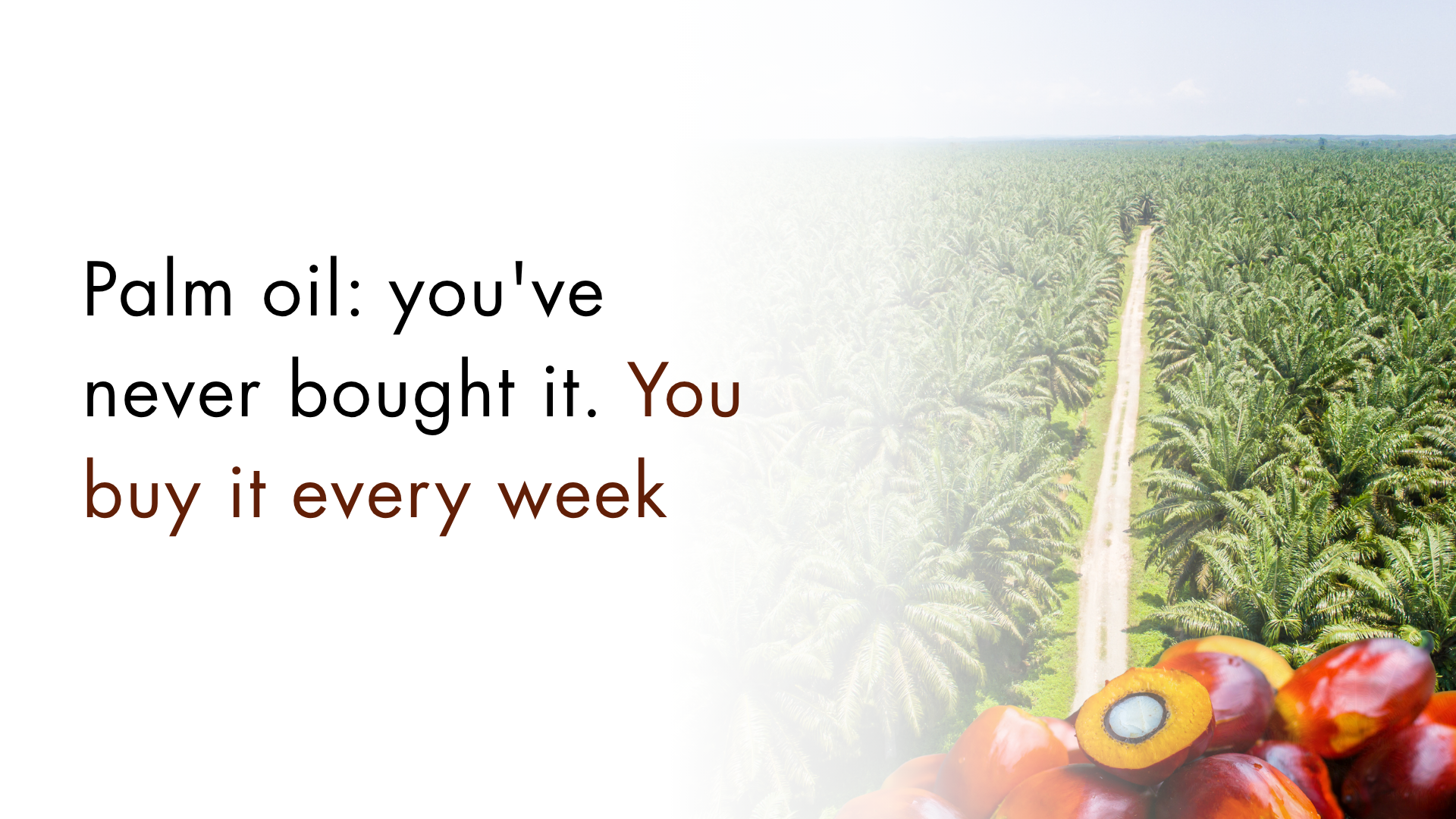
You have almost certainly never bought a bottle of palm oil in your life. And you have almost certainly never come home from the shops without some. It's in biscuits and bread, margarine and ice cream, lipstick and laundry powder — by the usual estimates, about half the packaged products in a supermarket. Two-thirds of the world's supply is eaten. Most of the rest is washed with.
Two hundred names is what it takes to be in that many places without ever being seen.
Why The Forest, And Why The Disguise
Because the oil palm is a kind of miracle. One hectare yields about four times the oil of a hectare of sunflower or rapeseed, which made it the cheapest fat on earth — and almost everything is now built from the cheapest thing that will do the job.
Not, mind you, to make anything cheaper for you. The same two hundred names sit in the $4 body wash and the $60 one. The cheap ingredient isn't there to lower the price; it's there to widen the profit — the space between what they pay and what you pay.
That space is the whole business.
And the disguise serves the same purpose, because a product that told you plainly what it was made of and why would have to share the profit with you.
The Renaming Came Here, Too
Because once you see it, you see it wasn't only the forest that got renamed.
Walk the aisles. "Soap" that is no soap at all — synthetic detergent pressed into a bar shape, built from palm kernel oil or petroleum, harsher on your skin than the thing whose name it kept. "Gentle." "Natural." "Pure." The forest was renamed into chemistry so you wouldn't recognise it. The chemistry was renamed into comfort so you wouldn't question it. The front of a pack and the back of a pack are written in two different languages, and only one of them is under oath.
And the country doing the shopping got renamed along the way. We grow some of the finest oils on earth, and so much of it leaves raw while the shelves fill with products built on the renamed forest — because two supermarkets own most of the shelf, and the shelf price is set by the cheapest fat on earth. Match the price or lose the shelf; match the price, and you use the names. Then inflation came, the checkout made the evening news, prices rose, and the names never left the labels. The regulator found the big chains' margins went up right through it.
We're paying more now for the renamed version of everything.
That's the part that never makes the poster. Before it costs a forest its trees, this way of making things costs a country its making — and costs all of us the ability to know what we're holding.
Where We Stand
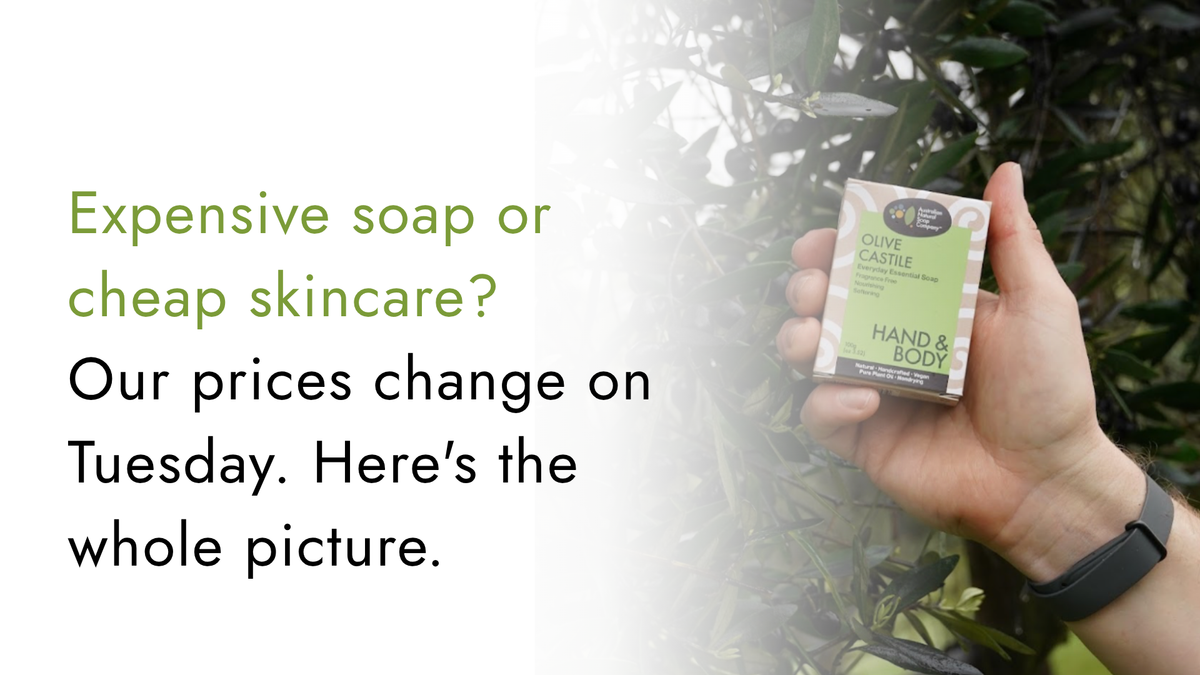
I should be plain about one thing. We sell soap — actual soap, cured for six weeks from whole plant oils, mostly Australian-grown, and in thirteen years we've never needed palm oil to make it. It costs more than a supermarket bar, and if this piece persuades you, we benefit.
So don't trust me, and don't trust the price, ours included.
The back of the pack is the only sentence in retail written under oath. Read ours too — it won't take you long.
Learning The Names Back
Between 2001 and 2016, palm oil drove about a quarter of Indonesia's deforestation. The first list — the hornbills, the rivers, the ironwood — is the ledger for that. It's why World Orangutan Day exists.
You can't fix a commodity market from a kitchen in Melbourne. Neither can I. But the two hundred names only work on people who don't look.
And here's the thing about the hunt. The codes are nearly all gone now — once used, dead, that was the game. But the names themselves don't expire. They're still out there, on the back of half the shop, doing their quiet work.
So that's the whole ask, now the fun is done. Not a donation, not a hashtag. Next time you're in aisle five, pick up something you buy every week and turn it around. Somewhere in that list you'll likely find one of the names — a laureth, a palmitate, an E471. And now you can do the translation yourself. You'll know it used to be called something else. Hornbill, maybe. Kinabatangan. Leuser.
You'll know what the forest is called now.
Real soap. Real names.