Why Plastic Free July isn't a campaign for us. It's just July.
·
·
I didn't start this business to save the planet.
I want to say that upfront, because the sustainability story is real — but it's not where this started. What drove me in 2013 was simpler and more selfish than that. I wanted to make soap that was genuinely good for skin. Real ingredients. Nothing synthetic. Nothing that stripped your skin barrier while claiming to nourish it. That was the whole brief.
The plastic thing came later. In the shower, actually.
I was deep in R&D — obsessing over formulations the way you do when you're building something from scratch and every batch teaches you something new — when I looked up one morning and really saw my bathroom for the first time.
Body wash. Shampoo. Conditioner. Shaving gel. Facial cleanser. A second facial cleanser because the first one wasn't doing what the label promised.
Every single one of them plastic. Every single one of them, I suddenly realised, replaceable. By soap. By the thing I was already making.
I stood there for longer than I'd like to admit.
That was the moment this stopped being a soap company and became something bigger. Not because I planned it that way. Because the logic was just sitting there, obvious, once I actually looked.
Here's what I think you should know about those bottles.
Most liquid soap — body wash, hand wash, the pump dispensers lined up on every bathroom shelf in Australia — is roughly 70 to 80 percent water. The active ingredient, the thing actually doing the work, is a small fraction of what's inside. The rest is water, synthetic detergent, preservatives to stop the water going off, and fragrance to make the detergent smell like something other than detergent.
You are paying for a plastic bottle of water with a small amount of synthetic detergent added. Repeatedly. Every few weeks. Forever.
Real cold process soap works completely differently. The saponification process produces natural glycerin as a byproduct — the thing that actually keeps your skin barrier intact. Commercial manufacturers strip that glycerin out and sell it separately because it's valuable. What's left is a detergent bar that cleans by stripping. Real soap keeps the glycerin. No fillers. No water. No synthetics. Your skin feels different after the first use.
That's not a marketing claim. It's chemistry.
And about that recycling bin.
I know it feels responsible. I used to feel that way too.
Australia recycles somewhere between 13 and 16 percent of plastic waste generated. The rest ends up in landfill or low-grade processing that produces material nobody actually wants to buy. Bathroom plastic is among the hardest to recycle — pump mechanisms are multiple materials bonded together, impossible to separate at a recycling facility. The economics simply don't work.
Recycling is not a solution to plastic. It's a management strategy for a problem we should be trying not to create in the first place. The only genuinely good outcome is the bottle that never exists.
I don't say that to make anyone feel bad about their bin. I say it because once I understood it properly, it changed how I thought about what we were building.
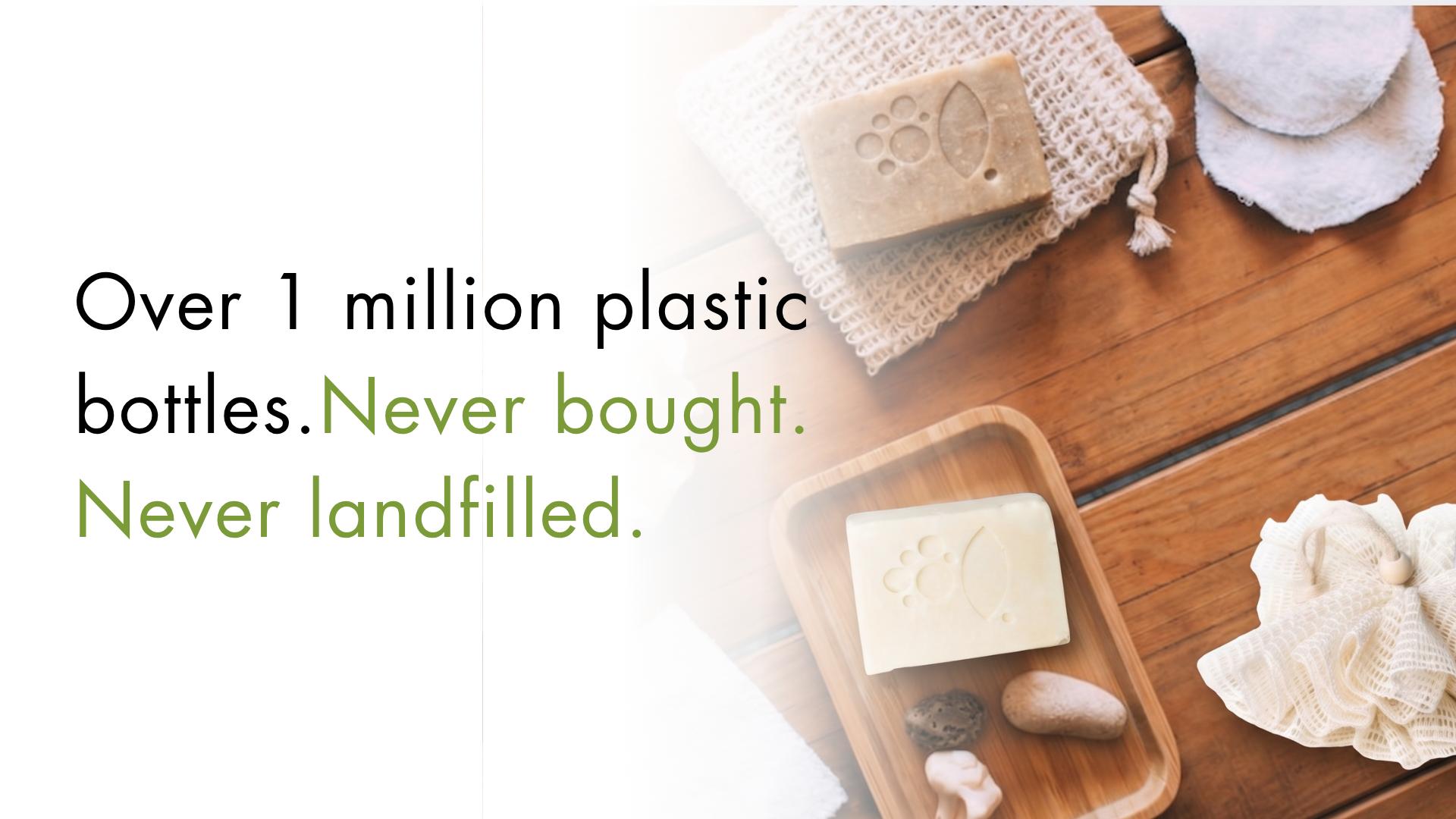
In thirteen years of making real soap, I believe our customers have collectively kept over one million plastic bottles out of circulation.
I've been sitting with that number for a while now. It's an estimate — we've never audited it, and I'm not going to pretend otherwise — but it's a conservative one. One bar, one bottle displaced. In reality most customers replace several.
Over a million bottles that were never manufactured. Never filled with water and detergent. Never pumped empty and placed hopefully in a recycling bin.
I find that genuinely staggering. And I'm proud of it — not because we set out to hit a number, but because it happened as a consequence of making something good enough that people stopped buying the alternative.
That's the version of sustainability I believe in. Not the one that starts with packaging. The one that starts with the product being worth switching to.
Plastic Free July isn't something we discovered this year. It isn't a buzzword we've attached ourselves to because July needed a theme.
It's just what we do. It's what we've always done, since a Melbourne kitchen in 2013, long before anyone was asking brands to perform sustainability for a month and then quietly go back to normal in August.
What's happening this month is us doing what we've always done — more completely than we've ever been able to before. We've spent years formulating, testing, and refining. The products dropping this July are the fullest expression yet of that shower moment thirteen years ago: the realisation that real soap could replace almost everything.
It starts Tuesday July 8. Everything after that — the bathroom, the kitchen, the laundry — follows through the month.
Over a million bottles. And we're just getting started.
Make sure you're on our list.
Soapy hugs,
Emma xx
Emma xx