The Beads Went. The Plastic Stayed.
Do you remember microbeads?
For a couple of years, they were the villain of every bathroom — tiny plastic spheres in the scrubs and washes on the shower shelf, going down the drain by the trillion, turning up inside fish. Australia's industry promised to phase them out, and by 2020 an independent survey found more than 99% of products on our shelves were microbead-free. The story ended. Everyone went home.
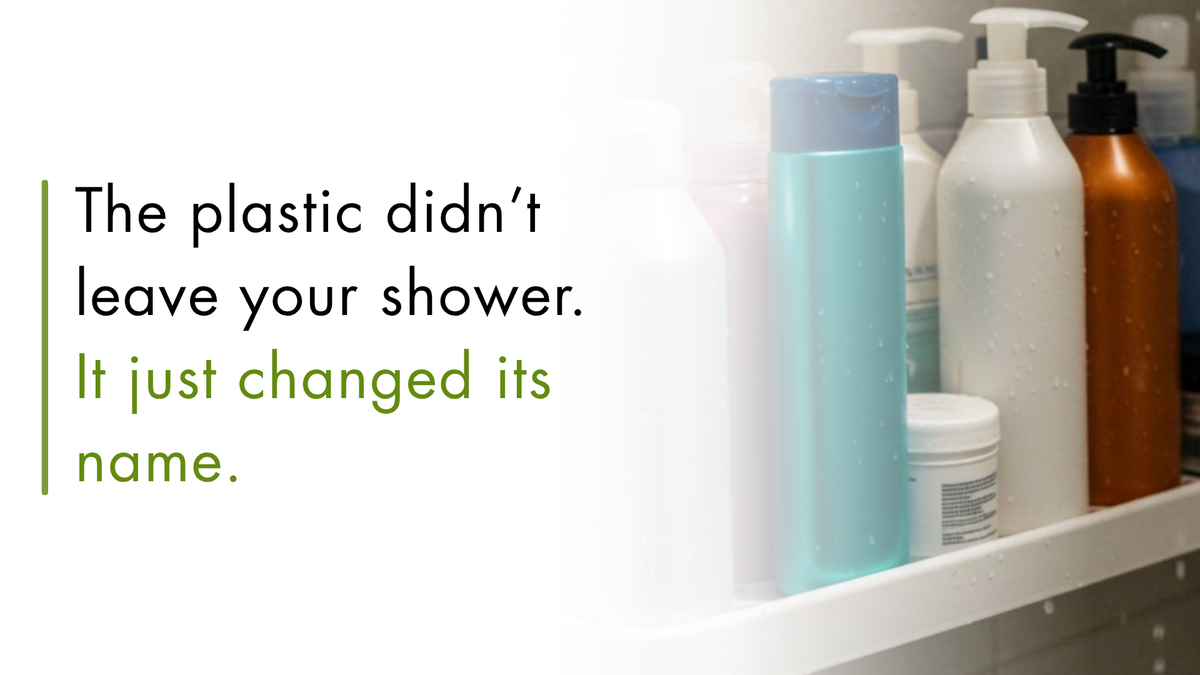
Here's what I want to show you today: the plastic never left the shower.
It stopped being a bead. It dissolved into the formula, changed its name to something you can't pronounce, and stayed right where it was — in the body wash, in the shampoo. The bead was just the version you could see.
The Bottle Is The Decoy
Be honest — when I say plastic in the shower, you picture the bottles. So did I, for years. And you've probably fought that war already - you're here right?
The industry is delighted for you to picture the bottle. The bottle is the plastic it can be seen doing something about — it gets the recycled percentage on the front, the ocean story, the triangle stamped underneath. The plastic in the formula gets no symbol, no percentage, no pledge. A brand can run a whole campaign about its bottle being 100% recycled while the wash inside is thickened, clouded and silkened with polymers from the same refineries that made the bottle. Both claims sit on the same shelf. Only one is on the front.
One honest thing before we go on, because a chemist will tell you if I don't: polymer does not mean plastic. Cellulose is a polymer — plants make it. Xanthan gum, in half the natural products you own, is a polymer — bacteria make it. Being a long-chain molecule is not the crime. The ones in this piece are the synthetic kind: built in a reactor from petrochemical feedstocks, by the same industry, from the same barrels, as the bag and the bottle. When they came as tiny spheres, we called them microbeads and banned them. Dissolved into a wash, they're called lots of things.
That's rather the point.
So I Read The Shower Shelf
You know how this works by now. Last time it was 34 soaps. The time before, 43 under-eye masks. This time: 30 products from the shower shelf of one of the biggest supermarkets in the country — 15 shampoos and 15 body washes, as published on its own website, taken in the order the shelf served them.
Nine of the fifteen shampoos carry a synthetic polymer. Five run on Polyquaternium-6, three on carbomer, and one — a brand with Naturals in its name — carries two polyquaterniums at once. And my favourite label of the fifteen: a shampoo whose front announces it is silicone-free. It is. The synthetic polymer it uses instead sits sixth from the end of the ingredient list, and the front didn't mention that part.
Seven of the twelve readable body washes carry one too. Every single wash from the biggest brand on the shelf — all four of them — has a polymer in it. So does the one positioned as gentle and soap-free. The best find of the audit: a milk-and-honey wash whose creamy, milky look comes courtesy of styrene/acrylates copolymer — an opacifier, microscopic polymer spheres that scatter light so the liquid looks rich. The milk in the milk-and-honey is plastic. The honey, to be fair, is honey. Its stablemate goes one better and pairs that opacifier with Polyquaternium-7, the clinging film, in the same bottle.
One brand publishes no ingredient list at all — three of its washes in my thirty, nothing disclosed online for any of them.
And the number I most want you to sit with: eleven of the twenty-seven readable products carried no synthetic polymer whatsoever. They weren't hiding in a specialty corner — ordinary shampoos and washes, same shelf, same kind of price. So when someone tells you this is simply what shower products are made of now, eleven bottles in one supermarket say otherwise.
It's not a law of chemistry. It's a formulation choice.
Why The $4 Wash Looks Like The $40 One
Here's the part nobody prints on the front. A bottle of body wash is mostly water. Water plus detergent is a thin, greyish liquid nobody wants to buy — so the formula gets dressed. A pinch of carbomer, a fraction of one percent, turns watery into gel. A dose of styrene/acrylates turns clear into cream. A polyquaternium leaves a film behind so your skin and hair feel conditioned the second you rinse.
None of these tricks cost real money. They're built from the cheapest carbon on earth, which is why the same polymer names sit in the $4 wash and the $40 one. That's the whole magic of the shelf: plastic is how water gets dressed up as milk, cream, silk and serum — for cents. The expensive bottle isn't paying for better chemistry. It's paying for the front of the label.
And the polyquaternium film deserves one more sentence, because it's the cleverest trick of the lot. It's a positively charged polymer that bonds to your hair and stays after you rinse — that's its job. The instant silky feeling from a "nourishing" shampoo isn't your hair getting healthier in ninety seconds. It's a coating.
Nourishment is one thing a polymer film cannot do.
Our Most Divisive Product, And Why
Now the part where I own something, because this piece has been pointing at everyone else's shelf.
Our shampoo bars are some of the most divisive products we sell. I know it. Some of you swear by them; some of you tried one, hated week two, and went back to the bottle. And the reason is exactly what this whole piece has been about.
If you've washed with commercial shampoo for years, your hair has been living in a cycle: strip it with detergent, then coat it with polymer and silicone so it feels instantly smooth. When you switch to a bar made of saponified plant oils, both halves of that cycle stop at once. No more strip — and no more coating. For somewhere between two and six weeks, your scalp recalibrates the oil it makes and the old film wears away, and in the middle of that your hair can feel heavy, or waxy, or just wrong. That's the adjustment period, and I won't pretend it isn't real. Some heads sail through it. Some don't get through it at all, and if that's you, I'd rather you know why than think you failed at soap.
But be clear about what the alternative is, because the bottle never says it: the "silky" you're going back to is Polyquaternium-6. The adjustment period isn't your hair breaking. It's your hair meeting water without a plastic coating for the first time in years — and deciding what it actually feels like.
The Fine Print On The Ban
Two things worth knowing while you're standing at that shelf.
Australia's microbead phase-out was voluntary, and it covered exactly this territory — rinse-off products. It succeeded at what it aimed at. It aimed at beads.
Europe went further, and the fine print is instructive. In 2023 the EU passed a real, legislated microplastics restriction; rinse-off cosmetics — the shower shelf — get until 2027. But read the definition, the letter stamped on the bottom of the law: it covers solid plastic particles. Polymers that are dissolved, soluble or liquid — the carbomers, the acrylates, the polyquaterniums — sit outside it entirely. The strictest microplastic rules ever written mostly cover the bead that industry had already given up, while the dissolved plastic doesn't legally count as plastic.
Nobody had to hide anything. They just had to write the definition carefully.
The Part Where I'm Supposed To Say It's Harmless
I'll be more careful than that, because the science has moved since the beads left, and not in a comforting direction.
Two things are true at once. The polymers dissolved in a wash are big, inert molecules that don't pass through intact skin — on that narrow point, the industry is probably right. And: researchers keep finding plastic inside us now — in blood, in placentas, in breast milk, in artery plaque, in brain tissue — and where the particles turn up, trouble keeps turning up with them. The researchers say association, not proven cause, and I'll say it with them, because you don't fix an honesty problem with exaggeration. As for the dissolved kind in your shampoo — nobody has shown it harms you. Read that sentence the way a journalist would. Nobody has shown. It's excluded from the legal definition of microplastic, which means it's barely studied at all. "Harmless" isn't a finding. It's a gap in the file.
And remember what a shower product is: one hundred percent of it goes down the drain, usually within about ninety seconds of being poured. Treatment plants catch some; what they miss goes downstream, into the same water and the same food chain the particle plastic is already reaching us through.
The drain is not a border. We are all downstream of our own bathrooms.
Where We Stand
You know the disclosure by now: we sell soap and shampoo bars, so weigh my words accordingly. A cured bar is its own thickener, its own texture, its own lather — it doesn't need a gelling agent, an opacifier or a film former, because it isn't water pretending to be cream, and it isn't pretending to stay on you. That's not virtue. That's just the recipe, and it's five thousand years old.
So don't take my word for anything. Take the bottles. Tonight, pick up your shampoo and your body wash and turn them around. Here's what to look for:
- Starts with "poly-" — e.g. Polyquaternium-6, Polyquaternium-7
- Ends in "-copolymer" or "-crosspolymer" — e.g. styrene/acrylates copolymer
- Short aliases — carbomer, styrene, PVP
Count what you find, and while you're there, notice what the front of the bottle chose to tell you instead.
You were told the plastic left the shower in 2018. Now you can check.
Real soap. Real ingredients.
Sources: Product ingredient lists as published on the retailer's own website, read August 2026 — 30 shampoos and body washes; the full data sheet is available and every product is one click away. Accord Australasia, BeadRecede program summary (independent survey for the federal Environment Department, November 2020). Regulation (EU) 2023/2055 on synthetic polymer microparticles. Beat the Microbead (Plastic Soup Foundation), ingredient database. Nihart et al., Nature Medicine, 2025 (brain); Marfella et al., New England Journal of Medicine, 2024 (artery plaque).