What Australian Made Means To Us
·
·
What Australian Made Week Means This Year
The Cost of Making Something
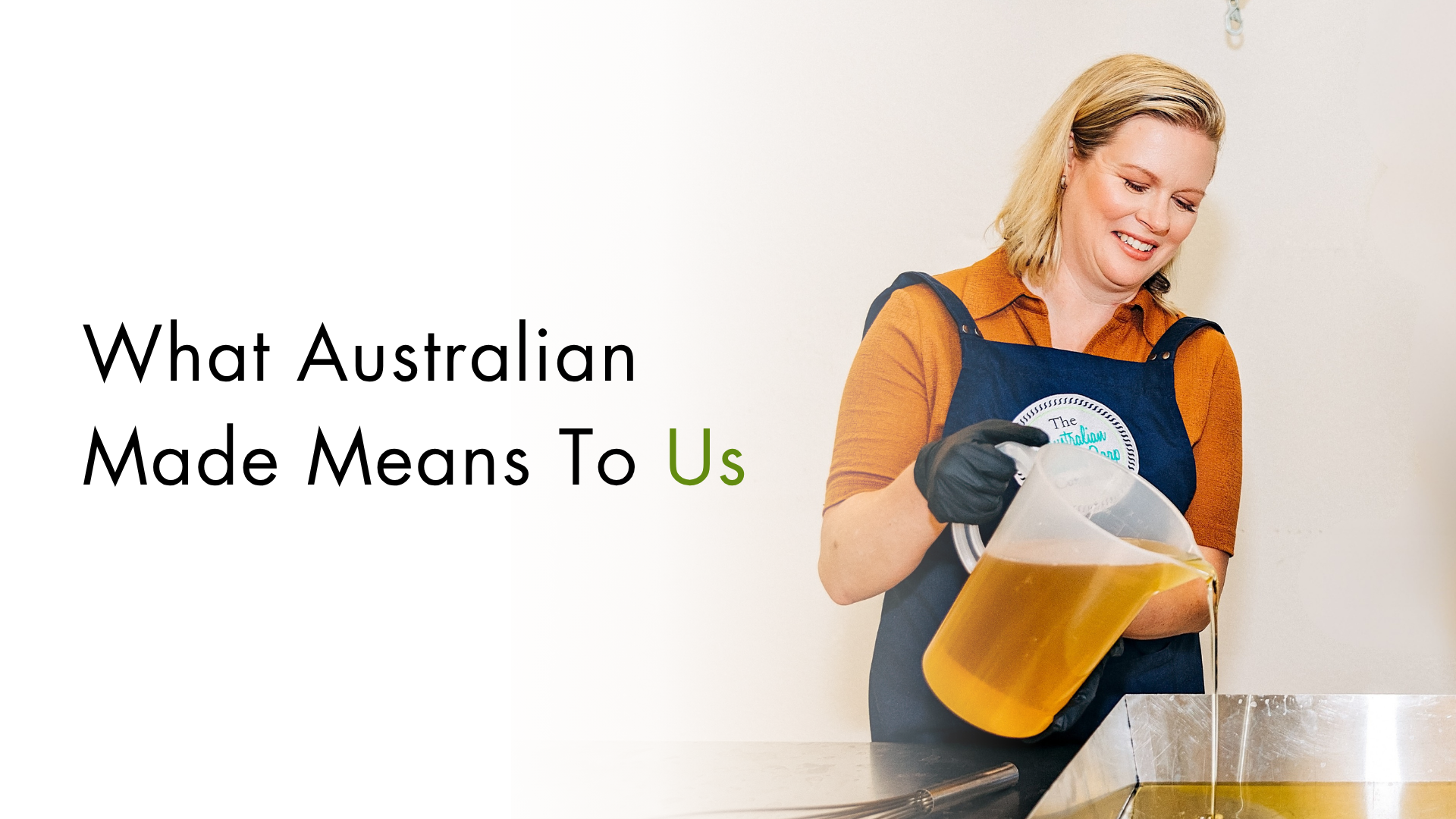
Somewhere in our Melbourne warehouse right now, there is soap being made, soap drying on racks, and soap being picked and packed for someone's bathroom shelf. That process has been running, in one form or another, since 2013.
For the last fortnight, I've been unwell. Not dramatically — no hospitalisation, no crisis — just the grinding kind of unwell that a small business owner cannot afford to acknowledge. So I didn't. I kept thinking, kept deciding, kept showing up in the ways that only I can, because that is the reality of building something that still, after more than a decade, relies heavily on you. I have a team I believe in. I have customers who have stayed with us through every phase this business has been through. And still, the machine doesn't run without me in it.
It wasn't until I physically couldn't continue that I permitted myself to stop. To sleep. To go for walks. To stop thinking about work for long enough to remember I'm a person, not just a founder.
I'm telling you this not for sympathy. I'm telling you because it is the most honest answer I can give to the question Australian Made Week asks every year: what does it actually cost to make something in this country?
It costs this. It costs people like me running on empty in high-inflation years, without the safety nets that existed during COVID, increasingly without government support that once helped us grow — and now, potentially, facing a federal budget that penalises the very founders who dared to build something from nothing.
The Market We Actually Compete In
Here is something worth understanding about the market Australian Made businesses compete in every single day.
A bar of soap on Temu costs less than a cup of coffee. It arrives at your door in a plastic wrapper, shipped from a warehouse overseas, having bypassed the environmental standards, safety regulations, and wage requirements that every Australian manufacturer operates under as a baseline. The supply chain that produced it is opaque by design. The money you spend on it leaves Australia the moment you click purchase and does not come back.
This isn't a moral argument. It's an economic one.
For years, overseas platforms like Temu could ship packages to Australian consumers entirely tax-free — no GST, no duty, no processing fees on anything under $1,000. That loophole has since been partially closed. Large platforms are now required to collect GST at the point of sale. But GST parity is not the same as a level playing field. Temu does not pay Australian wages. It does not pay Australian commercial rent. Its manufacturing supply chain is not subject to Australian environmental or safety standards. Collecting 10% GST at checkout is the bare minimum — it does not account for the decade of regulatory compliance, ethical sourcing, and genuine community investment that Australian manufacturers carry as a baseline cost of doing business here.
When Australian consumers buy from platforms built on hyper-cheap overseas manufacturing, they are not just choosing a product — they are choosing which businesses survive. Local manufacturers pay Australian wages, Australian commercial rent, and Australian taxes. They source ingredients where they can from Australian suppliers. They comply with Australian standards because those standards exist to protect people — the workers who make the products and the customers who use them.
We cannot compete on price with a supply chain that has none of those obligations. We were never supposed to. What we can compete on is integrity — of ingredients, of process, of provenance.
So we keep making soap. Properly. In Melbourne.
Then the Budget Landed
And then last week, the federal budget landed.
There was something in it for small business — a permanent instant asset write-off at $20,000, which is genuinely useful, and I'll take it. But buried in the same document was a proposal that should concern anyone who has ever considered building something in this country.
The capital gains tax discount — the mechanism that has historically softened the tax burden on founders who sell a business they've spent years building — is on the table. If it goes, founders who exit face a tax rate of up to 47 cents on every dollar of gain. Not 47 cents on passive investment income. 47 cents on sweat equity.
Let me put that in real terms. Thirteen years ago, I was a well-paid public servant. I walked away from that salary to build this. What I pay myself now is not comparable — it hasn't been for years, and that is a choice I made consciously because I believed in what we were building. That gap between what I could have earned and what I have earned is not recoverable. It lives in the business. In the products. In the team. In the customers who've stayed with us through every phase.
So when a government proposes taxing a founder's exit gain at 47% — the gain that represents years of deferred wages, personal financial risk, and 6 am starts — it is taxing something that was never passive. It is treating a decade of building something from nothing as equivalent to a lucky share trade.
The government was not there for the phases that didn't work. It was not there for the pivots, the rebuilds, the fortnight of working through illness because stopping felt impossible. But it will be there — as a mandatory, silent partner who took zero risk — at the moment of success.
I've been fortunate. Australian Natural Soap Company has received grants over the years that have helped us grow. There was real support during COVID that kept small businesses like ours alive. But in these high-inflation years, that support has largely disappeared — and a budget that offers one hand while pulling back with the other doesn't fill the gap.
Why This Week Matters
Australian Made Week launches Monday. And this year, for the first time in a while, I think it means something beyond a green-and-gold sticker on a label.
It means something because the context has changed. Because the platforms competing for your dollar have never been more sophisticated, more aggressive, or more disconnected from the communities they sell into. Because the regulatory environment that could level the playing field keeps failing to do so. Because the budget that landed last week sent a message — that building something in this country is your problem to solve.
And yet people keep building. In warehouses in Melbourne and factories in regional Queensland and workshops in suburban Perth, there are people making things properly, paying people fairly, and staying because they believe the alternative — a market hollowed out by cheap imports and indifferent algorithms — is worse for all of us.
Buying Australian-made is not a charitable act. I want to be clear about that. Nobody needs your pity purchase. What Australian-made businesses need is customers who understand what they're choosing between — and choose accordingly.
When you buy from a local maker, that money stays. It pays a wage. It funds a lease. It keeps a supply chain alive that employs people you probably live near. It supports a business that is subject to the same standards — environmental, safety, ethical — that you expect to be protected by yourself.
When you buy the $3 alternative, you are not just saving $3. You are participating in a system that is slowly making it impossible for the $3 alternative to have a local competitor at all.
This is not inevitable. It is a choice. Yours, made one purchase at a time.