What the sea gives you — and what we give back
·
·
I've been spending a lot of time on the Bellarine Peninsula lately.
Not by design, exactly. Recovery has a way of making decisions for you — and for me, it kept pulling me back to the coast. Even in the cold. Especially in the cold, actually. There's something about a winter beach that a summer beach can't give you. Fewer people. More sky. The kind of quiet that has texture to it — wind, and waves, and the occasional determined seagull, and not much else.
I'd walk the same stretches most days. Nothing dramatic — just moving, breathing, watching the water do what water does. And I noticed, fairly quickly, what it was doing to me. The particular quality of calm that settles in after twenty minutes by the sea. The way the noise in my head — the to-do lists, the business decisions, the general low-grade hum of running a small company — would just... recede. Not disappear. Recede. Like a tide going out.
It turns out there's a name for this, and a growing body of research behind it. Scientists studying what they call "blue space" — time spent near oceans, rivers, lakes — have found measurable effects on mood, stress hormones, and mental health outcomes. The University of Exeter has published extensively on it. The findings are striking: people who regularly visit blue space report significantly better mental wellbeing, and the effect holds even after you account for income, exercise habits, and all the other variables researchers like to control for. Some studies suggest the impact on overall wellbeing is comparable to the effects of antidepressant treatment.
I believe it. Not because I've read the studies — I had, but I'd have believed it anyway. My body knew before my brain caught up. We evolved next to water. Our nervous systems haven't forgotten, even if the rest of us has got distracted.
So there I was. Recovering. Walking. Feeling, for the first time in a while, like I was part of something larger than my own immediate problems.
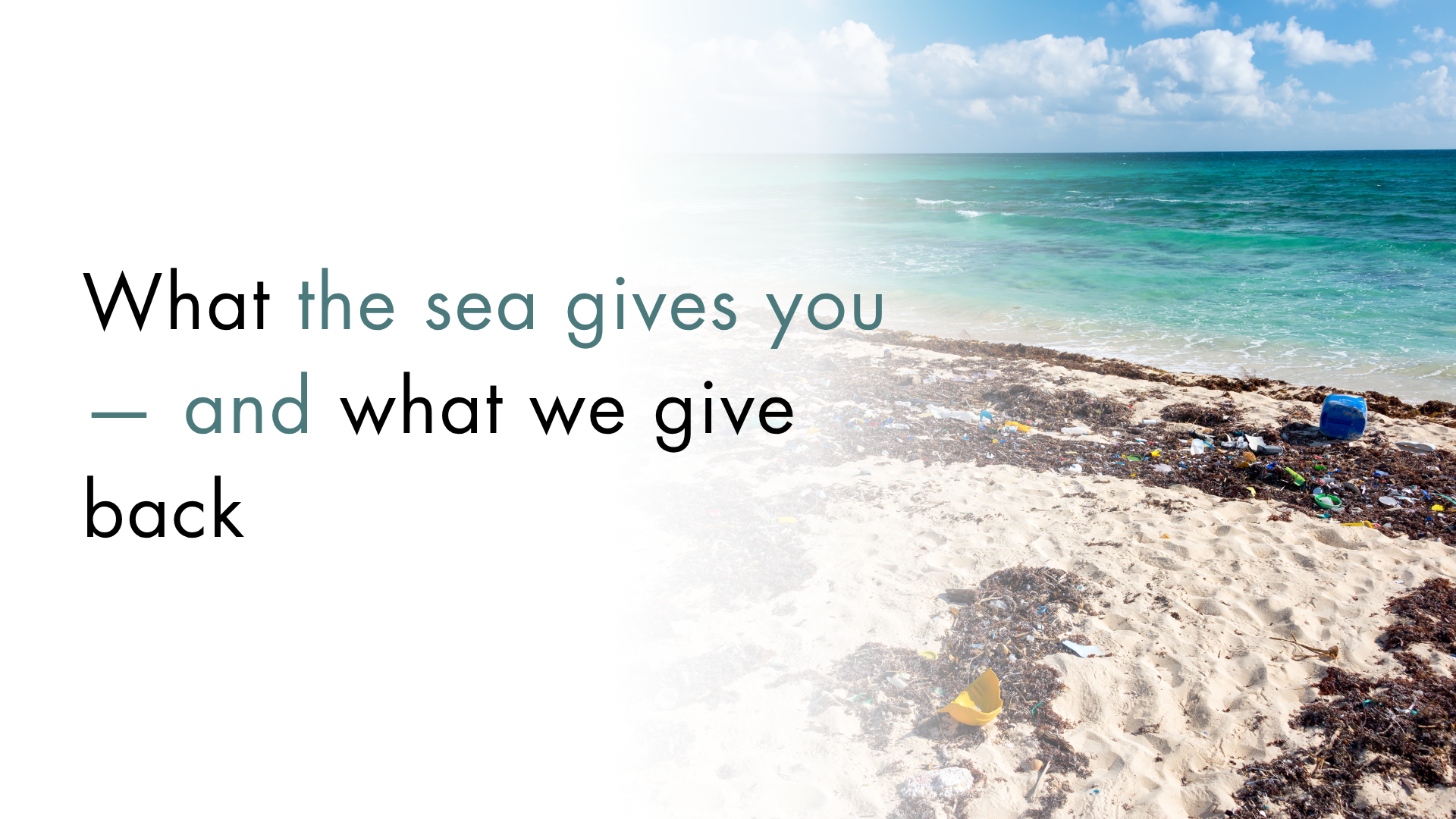
And then I'd look down
Bottle caps, mostly. The small plastic kind — from water bottles, soft drink bottles, the detritus of everyday convenience. Wrappers. The odd fragment of something that used to be something else and is now just... plastic. Small enough to overlook if you're not paying attention. I was paying attention.
I'd pick them up. Put them in my pocket. Walk on. And I'd think about where they came from — not this beach specifically, but the system that delivers them here. Because they don't arrive by accident.
Most of us believe, in a vague and reassuring way, that we've got the plastic problem handled. We recycle. We separate our bins. We feel, if not virtuous exactly, then at least absolved. What most of us don't know — what I didn't fully reckon with until I looked more carefully — is how thin that absolution actually is.
Bottle caps, for a start, are too small for most recycling sorting machinery. They go to landfill, even when you've done everything right. But the larger problem is structural. In 2018, China — which had been processing the majority of the world's recycled plastic — stopped accepting it. What was already a fragile system largely collapsed. A significant proportion of what Australia puts in its recycling bins still ends up in landfill, or worse. The infrastructure to actually close the loop has never been properly built.
And then there's the journey those fragments take before they reach the ocean. Melbourne's stormwater network — the drains that collect runoff from streets, gutters, car parks — flows largely untreated into waterways and eventually into Port Phillip Bay. Every piece of litter on a footpath, every synthetic fibre shed from a washing machine load, every tyre particle worn off on a road — a significant portion of it travels that route. No filter. No treatment. Straight in.
The bottle caps I was picking up on the Bellarine didn't wash up from nowhere. They came through us. Through the ordinary infrastructure of how we live.
We ate the ocean
Microplastics — the fragments that plastics break into as they degrade, never actually disappearing, just getting smaller — have now been found in human blood, breast milk, and placentas. In the lungs of people who have never worked in a plastics factory. In the stomach contents of seabirds thousands of kilometres from the nearest inhabited coast. In fish. In the shellfish we eat.
More recently, researchers have found microplastics in human heart tissue. In brain matter.
We didn't just pollute the ocean. We ate the ocean. It came back to us through the food chain, through the water, through the air. The idea that we could fill the sea with plastic and remain somehow separate from the consequences has always been a fiction. The science is just finally catching up to what the evidence was always showing us.
A pocket full of bottle caps
I keep thinking about the strange intimacy of those winter walks. Going to the coast to restore myself — because something in my body knew it needed to be near water — and finding, at my feet, the evidence of how little we've valued the thing that restores us.
We talk about the natural world as though it's something outside of us. A resource. A backdrop. Something to visit on weekends and protect in theory and treat, in practice, as a drain. But standing on a beach in June with a pocket full of bottle caps, feeling genuinely better than I had in weeks just from the act of being there — I couldn't make that separation hold.
We are not separate from this. We came from it. Our nervous systems run on it. The research on blue space isn't discovering something new — it's measuring something ancient, something our bodies have always known. The ocean isn't therapy. It's home. We've just built so many walls between ourselves and that fact that we've forgotten it.
Monday is World Ocean Day. I'm not sure what we're supposed to do with that information, exactly. I don't think one day of awareness closes the gap between how we live and what we know. But I do think the gap starts, for most of us, not with policy or infrastructure or industry — it starts with whether we actually feel connected to the natural world, or whether we've convinced ourselves we've graduated from it.
I hadn't, until those walks, felt that connection properly in a long time. I'm glad I found it again. I'm sad about what I kept finding at my feet.
Those are the two things. I don't think they resolve. I think that's the point.
Soapy hugs,
Emma xx
Emma xx